What the procedure is
Janu refers to the knee. In this external form of Basti, a selected oil is held over an area of skin within a retaining boundary. The materials and the person receiving care are supervised by a professional team. It is a local application, not an injection into the knee and not a rectal Basti procedure. Those interventions have different routes, purposes and risks.
The word Panchakarma is sometimes used broadly for a range of associated external therapies. Seeing Janu Basti within that category does not mean that everyone with knee discomfort needs a full cleansing programme. The exact proposal should be explained, including which elements are being considered and which are not.
Before selecting a named therapy, ask what the assessment suggests about your knee. A person with a recent injury, a suddenly swollen joint, established osteoarthritis or a previous knee replacement may need very different decisions. A local procedure should be considered in the context of those differences, rather than offered because the same body part is painful.
Why the cause of knee pain matters
Knee pain can arise from an injury, a joint condition or tissues around the joint. Sometimes symptoms are affected by problems elsewhere in the leg or body. The location and pattern can provide clues, but an online description cannot reliably establish a diagnosis. A clinician considers your history, movement, examination and any investigations needed to answer a specific question.
Explain whether the problem began suddenly or gradually and whether it followed a fall, twist or unusual activity. Say whether one knee or both knees are affected, where the pain is felt and whether swelling occurs. Mention locking, giving way or difficulty bearing weight. These details can be more useful than a general statement that the knee feels weak.
Do not assume every painful knee is osteoarthritis or that an old diagnosis explains a new event. A hot swollen joint, particularly with fever or marked illness, needs prompt medical assessment. An external warming procedure should not be used to cover an unexplained deterioration while waiting to see what happens.
If osteoarthritis has already been diagnosed
Osteoarthritis is a joint condition that can affect comfort and function in different ways. The experience is not determined by one X-ray phrase or by age alone. Some people are mainly troubled by walking, others by standing, stairs, sleep or a particular task. The care discussion should reflect the actual difficulties, not only a report describing structural changes.
Bring previous reports and the advice you have already received. Imaging is not automatically required again because a complementary procedure is being considered. A clinician decides whether a new investigation is likely to change management. It is reasonable to ask what information a test would add and how the result would influence the plan.
An external oil application should not be advertised as rebuilding cartilage, restoring a worn joint to a new state or making every future operation unnecessary. Supportive care can still have a useful purpose when the goal is clear, expectations are realistic and established management continues where needed.
Describe the activities affected
Choose examples from your own routine: standing from a chair, using stairs, shopping, entering a vehicle or managing household tasks. Explain how the knee behaves during the activity and how long it takes to settle afterwards. A person who walks short distances comfortably but struggles with stairs has a different problem to solve from someone who cannot safely bear weight.
Tell the clinician about fear of falling or giving way. Avoid repeatedly forcing a painful task simply to demonstrate that symptoms are present. You can describe it, show a safe version or explain what assistance you normally need. The purpose of assessment is to understand function, not to prove how much discomfort you can tolerate.
Your priorities should influence the goals. For one person, a manageable walk with family may matter most; for another, it may be returning to work or sleeping more comfortably. A goal connected to life is easier to evaluate than an undefined promise of complete joint rejuvenation.
Health information to bring
Include injuries, previous operations, injections, inflammatory arthritis, gout, infections and any established neurological or circulation problem. If you have had a knee replacement, bring the operation details and current advice from the orthopaedic team. Tell the clinician whether swelling, warmth or wound problems have occurred since the procedure.
Provide a list of medicines and supplements, including pain treatment, blood thinners, diabetes medicines and products used on the knee. Mention allergies and reactions to oils, creams, fragrances or other topical preparations. A product described as Ayurvedic or natural can still be unsuitable for an individual.
Explain general health issues that may affect positioning, sensation or tolerance of heat. The area being treated is small, but the person’s wider health remains relevant. The clinician should decide whether the application is appropriate, needs modification or should be deferred for another assessment.
What a supervised session may involve
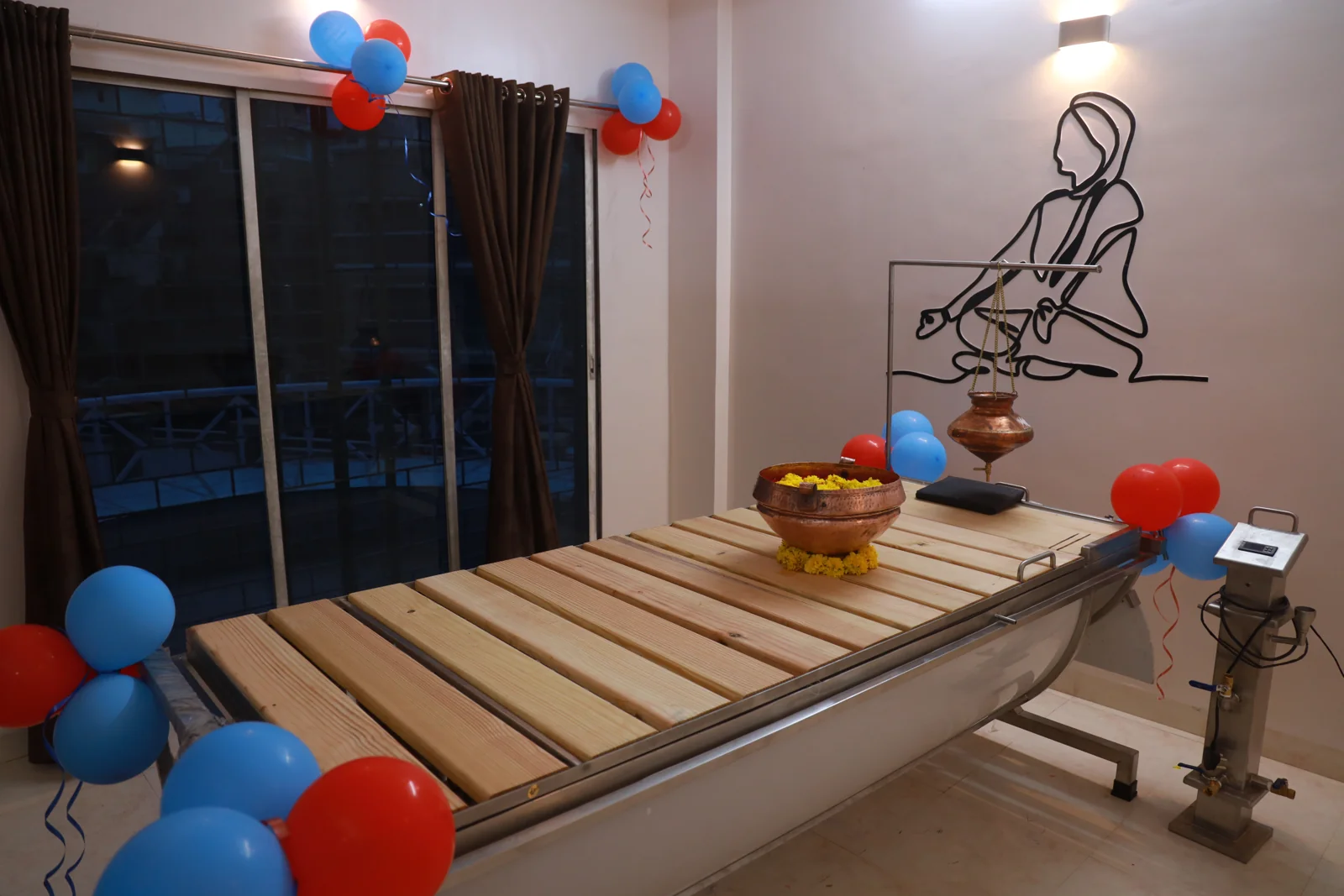
The clinician and team should identify the knee area, explain the selected material and discuss the purpose of the proposed session. The knee is supported in a position that is practical and tolerable. Any need for help getting onto the treatment surface or moving afterwards should be discussed before starting.
The external retaining boundary and oil application are prepared and managed by trained staff under the relevant professional plan. For patients, the key points are knowing what will contact the skin, how comfort is monitored and how to request a pause. This is an explanation of the experience, not a home-treatment method or a guide to selecting a preparation.
You should not have to keep a painful knee forcibly straight or bent to fit the setup. Tell the team about burning, itching, increasing pain, dizziness or any other unexpected symptom. The procedure should respond to the patient’s condition rather than continue simply because a standard duration or package has been planned.
Traditional purpose and possible supportive value
Ayurvedic discussions of joint discomfort may consider Vata-related qualities, stiffness, dryness and the person’s broader clinical pattern. A local oil-retention procedure can be explained within that framework. Traditional reasoning should not be presented as a laboratory finding or automatically equated with a modern structural diagnosis.
Some people may experience temporary comfort, relaxation or a sense of reduced tightness from a supervised local application. Those experiences can be worthwhile to discuss, especially if they help participation in a wider care plan. They do not demonstrate that cartilage has regenerated or that an underlying inflammatory or mechanical problem has been removed.
The positive purpose of a consultation is to make the next step clearer. That may mean considering a supportive procedure, prioritising rehabilitation, reviewing another treatment or deciding that further assessment should come first. An individualized approach does not require promising that the same therapy benefits every painful knee.

How to read claims and evidence
Professional Ayurveda institutions list Janu Basti, and government practice guidance describes external Basti. These references support the terminology and professional context. They do not establish that every advertised outcome is proven. The external-Basti guideline also notes limitations in the available trials, which should remain visible when discussing benefits.
When several interventions are used together, improvement cannot automatically be attributed to oil retention alone. Exercise, medicines, changes in activity, natural variation and the care setting can all influence the experience. A meaningful research comparison asks what was measured, in whom, against what alternative and for how long.
Be careful with a claim based only on a testimonial, a scan image or an institutional logo. A good discussion identifies which evidence relates to your condition and where uncertainty remains. You can ask how that uncertainty affects the proposed plan and what would make the clinician reconsider continuation.
Keep appropriate movement in the plan
For people with osteoarthritis, tailored therapeutic exercise is an important part of established care. The starting point depends on symptoms, balance, strength, medical conditions and previous activity. Ask whether physiotherapy or another rehabilitation assessment would help. A named external therapy should not be presented as a substitute for an appropriate movement plan.
If activity has become frightening, discuss that openly. The clinician can help distinguish a temporary precaution from unnecessary long-term avoidance. The aim is to find manageable participation rather than to push through every symptom or to stop moving indefinitely. A general website cannot prescribe the right exercises for every knee diagnosis.
Bring any postoperative or rehabilitation instructions already given. Conflicting advice can make a plan difficult to follow. Ask who coordinates the different parts of care and how a change in symptoms should be reported. Supportive treatment is most useful when it fits the wider plan rather than competing with it.
Discuss nutrition and weight respectfully
Weight-related support may be relevant to some people with knee osteoarthritis, but the conversation should be individual and respectful. Nutrition, mobility, medicines, medical conditions and practical circumstances all matter. Knee pain deserves appropriate assessment at every body size, and a person should not feel that care is being withheld until a number changes.
If weight management is a shared goal, ask for sustainable support that fits familiar foods, appetite and daily routine. Rapid-loss promises or a detox package should not be presented as the answer to every knee symptom. Sweating or a temporary change in body weight does not demonstrate permanent fat loss or joint repair.
People with diabetes, kidney disease, pregnancy or other nutrition-related needs may require specific professional advice. Do not adopt a restrictive diet simply because it appears on a therapy page. A useful nutrition discussion supports overall care without creating unnecessary food fears or replacing indicated treatment.
Local skin, scars and sensation
Explain a rash, eczema, open wound, infection, new skin change or recent treatment over the knee. A healed surgical scar and an unhealed incision are different situations. The treating team should decide whether a local application is appropriate, and products should not be put over a fresh wound without the responsible clinician’s advice.
The oil and the retaining material can both cause irritation in susceptible people. Tell the clinician what has reacted in the past, even if the reaction occurred to a product used elsewhere on the body. If a new symptom appears during the application, report it rather than assuming discomfort is an expected sign of benefit.
Reduced sensation can make heat harder to judge. Diabetes-related neuropathy and other nerve problems should be disclosed. Warmth that feels tolerable to one person may not be safe for another. Professional monitoring and individual selection are more important than simply asking whether the application feels hot enough.
Practical support and travel arrangements
If the knee is unsteady or painful, ask about assistance with getting on and off the treatment surface. Tell the team if you normally use a walking aid or need help with steps. These details are relevant to safety and dignity, not signs that you are an unsuitable person to ask about care.
Your journey matters too. Consider whether driving, riding a two-wheeler or using public transport is manageable on the day. If you cannot safely control a vehicle or bear weight sufficiently, arrange help and seek appropriate clinical advice. Travel decisions should reflect the actual condition of the knee and any care received.
Before committing to repeated visits, discuss realistic scheduling, access and support needs. A plan that cannot be attended safely or does not fit everyday life may need adjustment. Confirm fees, the proposed number of reviews and what happens if a session is missed or the course is stopped.
Evaluate lasting usefulness, not just a pleasant session
Agree on what you want to review before starting. For example, can you perform a familiar task with less interruption, walk with more confidence or sleep more comfortably? A clear goal helps you describe whether any benefit matters beyond the treatment room. It also gives the clinician a reason to continue, modify or stop the plan.
At review, describe how long comfort lasted, whether swelling changed and what happened during ordinary activities. Mention exercise, medicine changes and unusually demanding days. A combined plan may be useful without proving that each component caused the improvement. The review should be honest about both positive changes and difficulties.
If there is no worthwhile progress, reassessment is appropriate. Another diagnosis, a different treatment or specialist input may need consideration. Repeating the same course indefinitely should not replace a decision about why symptoms remain troublesome. Care can remain hopeful while recognizing that a particular option has not helped enough.
When the knee needs prompt assessment
A suddenly hot, swollen or very painful knee, particularly with fever or feeling unwell, needs prompt medical assessment. Difficulty bearing weight, a significant change in shape after injury or inability to move the knee also requires appropriate urgent advice. Do not wait for routine therapy to see whether oil or warmth settles the problem.
A replaced joint with new warmth, swelling or significant pain needs attention from the relevant medical team. A previous operation does not make a new symptom automatically harmless. Give the team the operation history and explain the change clearly.
If a clinician recommends an urgent investigation, surgical assessment or other necessary treatment, a supportive Ayurvedic procedure must not delay it. An informed choice includes understanding when a different level of care is more appropriate and how to reach it.
A supportive procedure does not close other options
An individual plan can change over time. If medicines, rehabilitation or another treatment have been proposed, ask how they fit together and who will oversee review. A choice to discuss Ayurvedic support does not require you to reject other care. Equally, considering an external procedure does not oblige you to continue it if the benefit is insufficient or the practical burden is too high.
Some people with significant knee disease eventually discuss an operation, while others do not need that option. The decision is based on the condition, symptoms, function, response to previous care and the person’s priorities. It should not be made from a single advertisement, a report phrase or a claim that all surgery can be avoided. If a surgical opinion is advised, you can use it to understand choices rather than treating the referral itself as a failure.
Ask for a clear explanation of what can reasonably be expected from each option. Good decisions compare the likely benefit, uncertainty, risks and recovery or follow-up needs. The discussion should leave you informed, without suggesting that you must choose between respecting Ayurveda and receiving necessary specialist treatment.
Notice confidence and participation as well as pain
Knee symptoms can affect independence long before a person describes the pain as severe. You may avoid a family outing because you worry about stairs, stop a hobby because getting up is difficult or rely on someone else for shopping. These effects belong in the clinical conversation. They help the team understand what a useful improvement would look like for you.
Progress may involve a more manageable routine or greater confidence with a particular task rather than a completely pain-free knee. Describe those changes honestly. At the same time, avoid lowering expectations so far that a burdensome course continues without a meaningful benefit. The review should balance comfort, function, safety, cost and your own priorities.