What the name tells you
Nadi refers here to the tube or channel used to direct steam, while Swedana means fomentation or the application of warmth. The name describes a method of delivery. It does not identify a diagnosis, specify the ingredients of a preparation or tell you which body region should be treated. Those details should follow an assessment and an explanation of the proposed care. A person asking about knee stiffness may need a different discussion from someone with new back pain or altered skin sensation.
The word Nadi is also used in other Ayurvedic contexts, including pulse assessment. Nadi Swedana is not the same thing as a pulse examination. Similarly, the word steam does not mean that any source of hot vapour is suitable for treatment. Professional equipment, control of exposure, positioning and continuous attention to comfort matter. The patient should understand the actual intervention rather than relying on the familiarity of the traditional name.
The traditional purpose, explained clearly
Within Ayurveda, warming procedures are discussed in relation to clinical patterns that may include stiffness, a feeling of heaviness and discomfort during movement. The reasoning may be described using Vata, Kapha and other traditional concepts. These concepts belong to an Ayurvedic framework; they are not interchangeable with a blood-test result, a scan finding or a modern diagnosis. A clinician should be able to explain both the traditional rationale and the practical goal relevant to the person being assessed.
An appropriate goal might concern temporary comfort or easier participation in a wider rehabilitation plan. It should not become a promise that steam repairs cartilage, reverses nerve damage or opens blocked arteries. Respect for a traditional method does not require exaggerating its effects. A useful care discussion can acknowledge why the method is considered while also explaining what remains uncertain and which established treatments should continue.
How it differs from other warming therapies
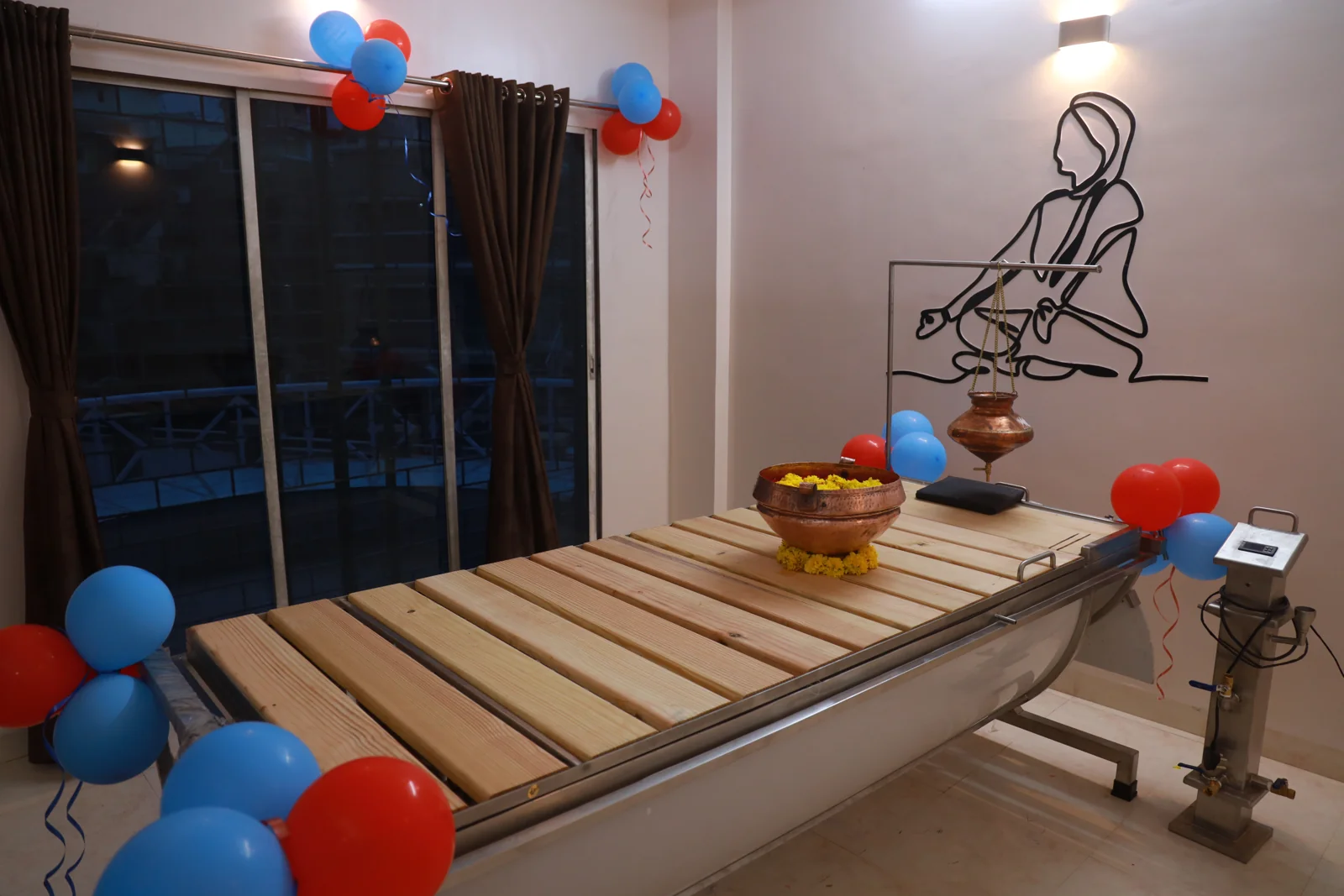
Swedana is a family of methods rather than one uniform treatment. Nadi Swedana uses directed steam. Potali or Pinda Swedana uses prepared bundles, while other forms may apply warmth more widely or use different materials. A warm room, a household heating pad and a local steam application are not automatically equivalent. Evidence, practical risks and the patient experience may differ, even when several options are grouped under the same traditional heading.
External oil-retention procedures such as Kati or Janu Basti are also distinct. They may appear in a combined plan, but adding them together does not mean that more treatment is necessarily better. Ask which component is being proposed, why it is being selected and how its contribution will be reviewed. The purpose of describing the different names is to help you make an informed decision, not to encourage choosing a collection of procedures from a menu.
Begin with the symptom rather than the procedure
A request for steam therapy is a starting point for discussion, not a diagnosis. Explain where the discomfort is, when it began, whether an injury occurred and which tasks are affected. Mention swelling, redness, fever, weakness or numbness. A familiar ache that has gradually limited walking may need a different plan from a suddenly painful hot joint. A symptom that looks minor on a photograph can still require examination before local heat is considered.
Describe the change you want to achieve in ordinary life. You might want to turn comfortably in bed, stand through a manageable part of a work shift or return to an advised exercise routine. Functional examples help the clinician understand your priorities. They also provide a practical basis for follow-up. A therapy should not be selected only because another person found it relaxing or because its equipment appears modern.
What an individual assessment may consider
Assessment may include the history of the main problem, a relevant examination, existing diagnoses and any investigations already available. The clinician decides whether another assessment is needed to explain the symptom or exclude a problem for which heat would be inappropriate. Not every person needs a scan, and a procedure enquiry is not a reason to arrange a standard bundle of tests. Bring existing reports rather than repeating them without a clinical question.
The conversation should also include current medicines, allergies, previous reactions to heat or oils, and practical matters such as the ability to lie or sit comfortably. An apparently local procedure still involves the whole person. Heart or kidney disease, diabetes, pregnancy, a recent operation, an acute illness or difficulty sensing temperature may alter the safety discussion. Some circumstances may lead to modification, postponement or a different form of care.
Reduced sensation needs particular attention
The ability to feel excessive warmth is an important protection. Diabetes-related neuropathy, some neurological conditions and previous injuries can reduce that ability. Tell the clinician if an area feels numb, unusually sensitive or different from the opposite side. Do not assume that a painless application must be harmless. A person who cannot judge warmth reliably needs an individual decision about whether the procedure is appropriate and how safety would be monitored.
The same principle applies if you have difficulty explaining discomfort, communicating in the language used by staff or staying in one position. Arrange a clear signal to stop before the session begins. An accompanying person may help with communication when you wish, but they do not replace professional supervision. A safe setting should adapt to the patient, rather than requiring the patient to tolerate a standard procedure regardless of their limitations.
Skin condition and recent treatment matter
Tell the team about rashes, wounds, infection, burns, unusual redness and previous skin reactions in the proposed treatment area. Recent surgery, injections or a dressing may also affect the decision. Skin that looks healed to a visitor may still need protection according to the treating team. Ask whether the area has been examined and whether local application is appropriate before anything is placed near it.
Avoid covering an unexplained skin change with an unprescribed product in preparation for the appointment. Describe products you have already used, including pain balms, patches and herbal applications. The clinician should consider what is currently on the skin, not simply what was used in a previous session. If irritation develops, prompt reporting is more useful than continuing because the procedure has been described as natural or traditional.
What to expect from the professional setting
Before treatment, the team should explain the intended body region, the method and the reason for choosing it. Privacy, clothing and draping should be discussed without embarrassment. You should know who performs the procedure and who is responsible for the clinical plan. If assistance is needed to get on or off a treatment surface, arrange it before starting. These details are practical parts of care, not optional extras.
A patient guide cannot verify the training, equipment or hygiene of a particular clinic from a photograph. Confirm the local arrangements directly. Ask how equipment is maintained, how materials are handled between patients and how unexpected symptoms are managed. A willingness to answer straightforward questions supports informed consent. A decorative treatment room or an attractive website should never be used as a substitute for that explanation.
The supervised session at a broad level
The usual patient-facing sequence is a suitability check, explanation and consent, positioning, the controlled local application, observation and aftercare advice. The exact method depends on the clinician’s plan. This overview deliberately does not provide equipment settings, distances, ingredients or timings for home use. Those details are professional responsibilities and cannot be selected safely from a general website.
During the application, report burning, pain, dizziness, breathlessness, nausea, distress or any unexpected sensation. Warmth should not have to be endured as proof of a successful treatment. Ask for a pause if the position becomes uncomfortable or the explanation is unclear. The team should respond to what is happening at the time, rather than focusing only on completing a predetermined session.
Reasonable expectations about comfort and movement
Some people may value the warmth, relaxation and temporary sense of reduced stiffness associated with a supervised local application. Those experiences can be described honestly. They do not establish that the underlying cause has been removed or that the same response will occur for another person. Before starting, decide which outcome would matter to you and when it would be sensible to review it.
A meaningful outcome may involve easier movement during a particular task or better tolerance of an existing rehabilitation programme. A single comfortable hour is different from a sustained improvement in daily function. If several treatments change at the same time, improvement cannot automatically be attributed to steam alone. Honest monitoring includes a lack of benefit, a short-lived response and any adverse effect, as well as a positive experience.
How to read evidence about Nadi Swedana
An institutional procedure list shows that a technique is used within an Ayurvedic setting. It does not establish the effectiveness of every application advertised elsewhere. A research paper may be relevant only to a particular condition, a specific method or a combined programme. Ask whether a claimed benefit concerns the same problem you have and whether the study measured an outcome that matters in daily life.
Small uncontrolled studies and individual case reports can identify questions for further research, but they cannot reliably predict a personal result. Traditional use, clinical experience and comparative research are different forms of information. A responsible explanation does not hide these distinctions behind the phrase scientifically proven. If evidence is limited, the care plan should reflect that uncertainty through realistic goals, monitoring and a willingness to reconsider the choice.
Keep active care and rehabilitation in context
A local warming procedure should not automatically replace an appropriate movement or rehabilitation plan. If exercise, physiotherapy or another treatment has been advised, discuss how the proposed session fits alongside it. The aim may be to make a wider plan more manageable, but the particular role needs to be explained. Avoid assuming that passive treatment alone addresses strength, balance, endurance or the practical demands of work.
Tell the clinician which activities you have stopped and why. Fear of movement, pain during a task and a specific medical restriction are not the same thing. Advice should respond to the actual diagnosis and your capabilities. The appropriate amount and type of activity cannot be prescribed from a procedure name. A gradual plan may be useful in some situations, while an acute or unexplained deterioration may require reassessment first.
Prepare without inventing a special regimen
Bring a current medicine list, relevant reports and a note of your main concern. Explain allergies and previous therapy experiences, including any reaction that seemed minor at the time. Ask whether there are specific instructions about meals, fluids, clothing or travel for the actual proposed session. Do not assume that fasting, extra water, purging or a restrictive diet is required because the word Panchakarma appears on a page.
People with diabetes, fluid restrictions or medicines affected by meal timing need individual instructions. Do not skip food or prescribed treatment on your own to fit a wellness routine. If you develop fever, diarrhoea, a new rash or another illness before the appointment, contact the team and explain the change. Rechecking suitability is more sensible than proceeding solely because a slot has been reserved.
Understand aftercare and the next review
Obtain advice that reflects what was actually done, your health and the response observed. Ask what activity is appropriate afterward, what to do if the skin becomes irritated and whom to contact if an unexpected symptom develops. Written guidance can help when several points are discussed at the end of a visit. Confirm the next review rather than assuming that a full course must be completed regardless of the response.
Before leaving, consider whether you feel well enough to travel independently. Dizziness, weakness or difficulty moving safely should be raised with staff. If a reaction develops later, describe when it began, where it occurred and what it feels like. Do not repeatedly apply another product to an irritated area without advice. Severe or rapidly worsening symptoms need appropriate medical care, not simply an online message awaiting a routine reply.
Use follow-up to decide whether the plan is useful
A brief record can focus on one or two activities, any new symptoms and whether a response lasted. This is more informative than a vague statement that the body feels detoxified. Explain other changes that occurred during the same period, such as medication, exercise, rest or workload. The clinician needs that context to interpret progress fairly.
If the benefit is insufficient, the next step may be to modify or stop the procedure, reconsider the diagnosis or obtain another professional’s opinion. Paying for a package does not make continuing clinically necessary. Agree in advance how progress will be reviewed and what would lead to a different plan. Good follow-up supports a useful decision, including a decision that a different type of treatment is more appropriate.
Common misunderstandings worth correcting
Sweating is not a measurement of toxin removal, weight loss or disease reversal. Temporary changes in body weight after heat can reflect fluid loss rather than a reduction in body fat. More intense sweating does not establish a better result. Similarly, feeling warm over a painful area does not prove that damaged tissue has healed. Use specific symptoms and function to describe a response.
Nadi Swedana is not a method for opening coronary arteries or replacing treatment for infection, a fracture or a neurological emergency. It is not the same as directing household steam toward the nose or face. A professionally selected local warming procedure has a defined context. Understanding that context allows a positive discussion of its possible supportive role without extending it to problems for which timely medical treatment is needed.
Symptoms that should not wait for a therapy visit
Seek prompt medical assessment for a new hot swollen joint, severe pain after an injury, inability to bear weight or a painful area accompanied by fever or feeling generally unwell. New weakness, loss of bladder or bowel control, or rapidly spreading numbness also needs appropriate urgent assessment. Do not treat these signs as evidence that a stronger warming application is needed.
New or severe chest pain, severe breathlessness, fainting or stroke symptoms require urgent hospital care. During or after a heat procedure, severe dizziness, confusion, extensive blistering or significant breathing difficulty should not be managed by waiting for a routine clinic reply. The appropriate response depends on the symptom, not on whether it occurred in a setting described as wellness care.
Plan the appointment around work and travel
A therapy appointment should fit around your actual responsibilities. Explain if you need to return to a physically demanding job, travel for a long period or care for someone at home. The clinician can clarify whether the proposed session creates practical limitations for you. Do not assume that everyone requires the same amount of rest or that immediately returning to a demanding task is suitable for every diagnosis.
If mobility is limited, ask about steps, access to the treatment area and help with changing position. Arrange an accompanying person when you want support. Clear information about the length of the visit, changing arrangements and follow-up can reduce uncertainty without making promises about treatment speed. A useful appointment leaves you knowing what was done, what to observe and what happens next.